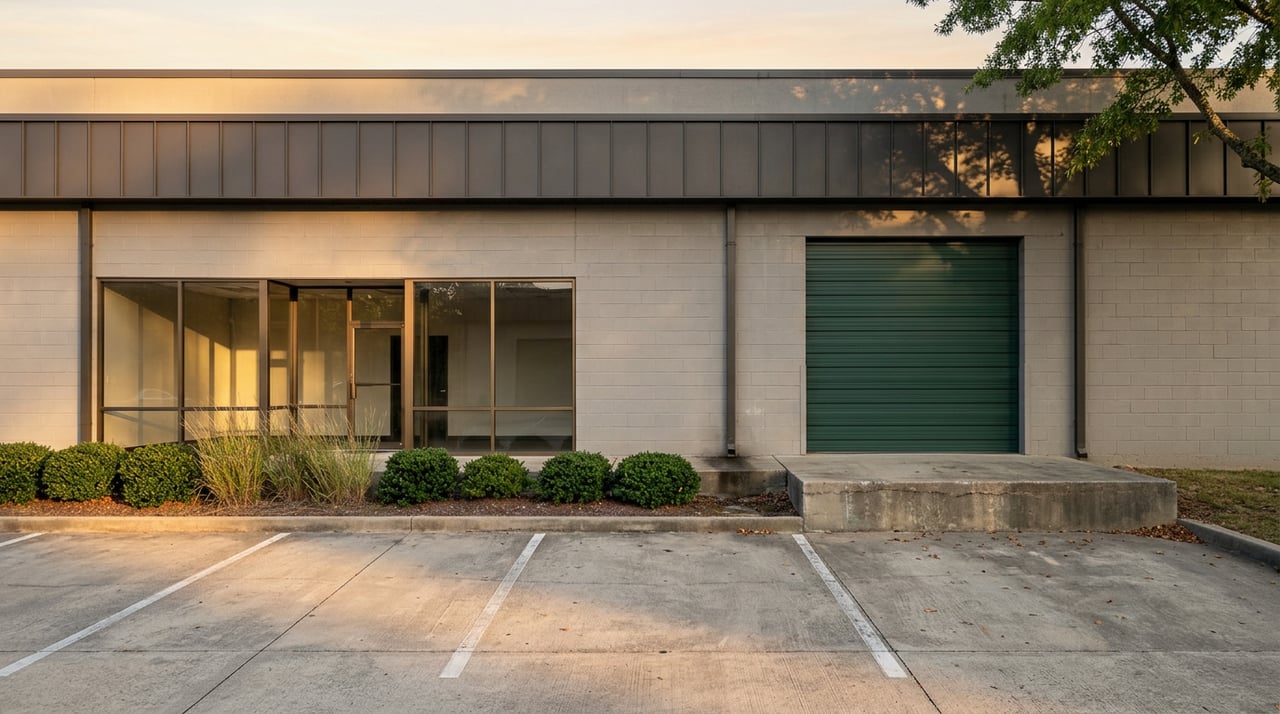
You called about a 15,000-square-foot flex space in Chantilly. Nobody called back. You found a warehouse listing near Manassas, priced it against last year's numbers, and the quote that came back made no sense. If you've spent the summer of 2026 trying to lease ordinary industrial or flex space in Northern Virginia, you are not imagining the problem. You are just fighting a different opponent than you think you are.
Most small business owners assume they're losing out to a hot economy. More companies, more demand, tighter supply. That story is true as far as it goes, but it misses the mechanism. You are not competing against other small tenants for space. You are competing against data centers, and data centers do not value land the way your business does.
You're Bidding Against a Different Kind of Tenant
A traditional warehouse tenant pencils out a lease based on throughput per square foot: how much product moves, how many trucks dock, how many jobs the space supports. A data center operator pencils out the same parcel based on how many megawatts it can pull from the grid. Those are not comparable numbers, and that's the problem. When a hyperscale cloud provider can generate far more revenue per acre than a logistics company ever could, it can also pay far more for the dirt underneath it, and for the buildings sitting on adjacent parcels that happen to have power access.
Colliers' Northern Virginia office has watched this play out directly. The firm's regional leadership has described data centers absorbing parcels that would, in an earlier market, have gone to ordinary distribution and fulfillment facilities. That's not a shortage caused by too many tenants chasing too little space. It's a shortage caused by one category of tenant that can outbid every other category by a wide margin, on every site that qualifies.
The Vacancy Rate That Isn't a Leasing Number
Here's where the numbers stop looking like a normal tight market and start looking like something else. CBRE's data on Northern Virginia's data center segment put vacancy at roughly 0.5 percent heading into 2026, with 96 percent of the year's scheduled new supply already spoken for before it delivers. In most commercial categories, a vacancy rate that low would be described as a leasing story: strong demand, landlords with pricing power. Here it's closer to a construction story, because there's essentially nothing standing to lease in the first place. Everything gets claimed before it's built.
That scarcity doesn't stay contained to data center campuses. It bleeds into the ordinary industrial market around it. Industrial rents across Northern Virginia climbed roughly 20 percent over the three years through mid-2026, about double the national average, according to market data reported this summer. Data center-linked tenants, whether the operators themselves or the contractors, riggers, and electrical firms that build and maintain their equipment, accounted for more than 40 percent of new industrial leasing in the DC metro area last year, up from just 13 percent the year before. That's a fourfold jump in market share for one tenant category in twelve months.
Closing One Door Didn't Relieve the Building
You might expect that regulatory limits on data center growth would ease the pressure on ordinary tenants. Loudoun County ended by-right approvals for new data center projects in March of 2025, which means every new proposal now has to clear public hearings and special-exception review. On paper, that sounds like friction working in favor of everyone else.
In practice, it hasn't relieved pressure on existing buildings. It slowed the pipeline of new supply while doing nothing to reduce the appetite of operators who already have capital committed and projects in the queue. When the front door gets harder to walk through, demand doesn't evaporate. It waits, and it competes even harder for whatever is already built and available, which is exactly the inventory your business is trying to lease.
Power availability compounds the same problem. Dominion's connection process for new large loads has been running on a batching system that stretches out timelines for anyone waiting on new grid capacity. Sites with existing high-voltage transmission access, useable water and sewer, and workable zoning are what's actually scarce now, more than raw acreage. That scarcity is pushing new data center development south along the I-95 corridor toward Stafford, Spotsylvania, and even Caroline County, chasing land where the entitlement path is still open.
What Owner-Users Are Already Doing About It
The clearest signal that leasing has gotten genuinely difficult isn't a rent number. It's who's choosing to buy instead of lease.
- A national moving and storage company closed a $90 million acquisition of two Class A warehouse buildings totaling roughly 241,000 square feet in Prince William County earlier this year, at full occupancy, rather than compete for lease space that wasn't available at any price.
- Loudoun's commercial market has shifted from data infrastructure being leased out by developers to being bought outright by the companies that operate it, with a single Ashburn campus acquisition running $427 million in the first half of 2026 alone.
If companies with real capital are deciding ownership beats leasing in this market, that tells you something about how thin the rental options have become for everyone smaller than them, too.
The Corridor That Works Today, and Why It Won't Last Forever
There is a real answer for small tenants right now, and it's geographic rather than financial. Prince William County's I-66 corridor is currently pricing below Loudoun's core industrial submarkets, and brokers active in the region point to it as where owner-users and tenants who got priced out of Loudoun and Fairfax are actually landing deals. The Route 234 spine in western Prince William is being flagged as the next corridor to watch as that pricing gap gets discovered.
Here's the part worth sitting with before you sign anything long-term. The same land-competition dynamic that emptied out Loudoun is already moving south along I-95 toward Stafford and Spotsylvania, chasing the exact combination of transmission access and open zoning that made Prince William attractive to data center developers a few years ago. The corridor that looks like relief today is adjacent to the corridor where the next round of competition is headed. Treat it as a window you can use now, not a market condition you can count on in three years.
What This Means If You're Signing a Lease This Year
If your business needs industrial or flex space in Northern Virginia in the next twelve months, the practical move is to widen your search radius before you're forced to, not after. Waiting for pricing to normalize assumes a correction that the power and land data don't currently support. Get comparable quotes across submarkets rather than anchoring to whatever your previous lease cost, because the gap between Loudoun and Prince William pricing right now is real and worth the extra commute for a lot of tenants. If you have the capital to consider ownership instead of a lease, this is the kind of market where that math increasingly favors buying, particularly for functional industrial space with clear title and existing utility service.
A Few Direct Questions
Is this only a Loudoun problem? No. Loudoun's zoning change in March 2025 pushed pressure into Prince William and, increasingly, into markets further south along I-95. The mechanism, land and power scarcity driven by data center economics, isn't confined to one county line.
Should I just wait for prices to come down? The data on power connection timelines and pre-committed 2026 supply doesn't point toward near-term relief. Waiting has a real cost if space in an adjacent corridor is available now at a meaningfully lower basis.
Does this affect office space too, or just industrial and flex? Industrial and flex are where the direct land competition shows up most clearly. Office has its own separate dynamics right now, driven more by tenant preference for quality space than by data center demand, though vacancy across the region has been declining for eight straight quarters as older stock gets repositioned or removed from the market.
If you're trying to figure out where your business actually fits in this market, whether that means chasing the Prince William window, weighing a purchase against a lease, or making sense of a quote that doesn't match what you researched, Dick Stoner has spent years reading CoStar data and negotiating commercial leases across this exact region. Request a free consultation before you sign anything.